

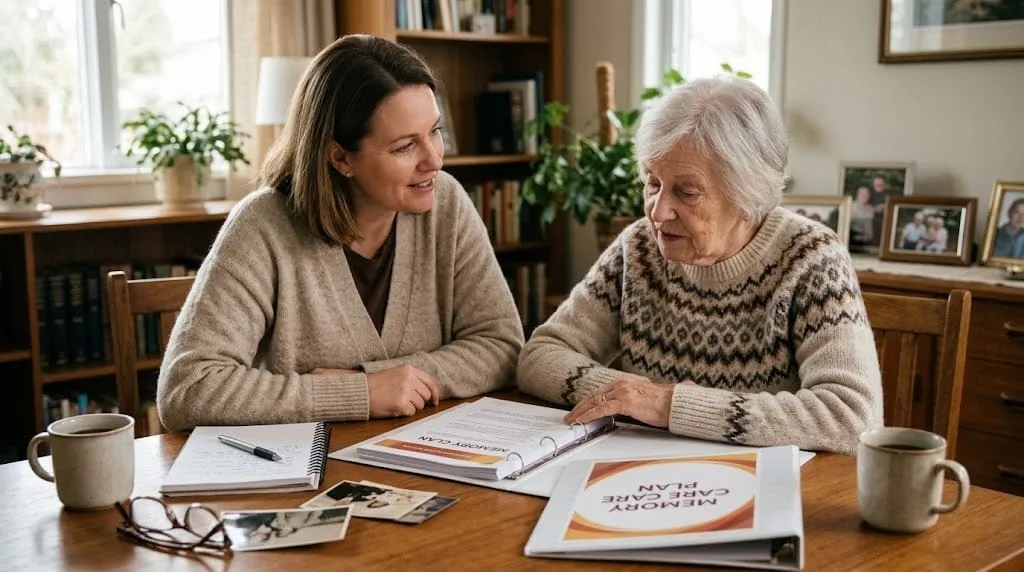
Families often first hear the term “memory care plan” after a diagnosis, fall, wandering incident, or hospital stay shows that informal support may no longer be enough. Creating the plan early lets the person with memory loss participate in care decisions instead of leaving the family to assemble it during a crisis.
A memory care plan for progressive memory loss is a written document that records a person’s current cognitive abilities, daily care needs, safety risks, and the specific support caregivers will provide. Review it regularly and update it as the person’s memory loss and level of need change.
Who Creates the Plan, and When
A team, not one person, typically builds a memory care plan. A physician or neurologist contributes the diagnosis and cognitive baseline. A nurse or care coordinator working in a memory care community, home care agency, or hospital discharge team translates that information into daily care tasks. Family members contribute details clinicians may not see during an office visit, including sleep patterns, mood changes, triggers for agitation, and sources of comfort.
According to the Alzheimer’s Association’s 2026 Alzheimer’s Disease Facts and Figures report, more than 7 million Americans are living with Alzheimer’s, and nearly 13 million Americans provide unpaid care for people with Alzheimer’s or other dementias. Much of that caregiving happens without a formal plan, leaving families to make important decisions under pressure. Start a plan as soon as a diagnosis is confirmed or a clear pattern of memory loss is documented, even if the person is still living independently. Starting early allows the person receiving care to contribute and gives the family time to prepare.
What the Plan Actually Includes
A complete memory care plan covers five areas:
- a cognitive and medical baseline (diagnosis, medications, known triggers)
- activities of daily living support (bathing, dressing, eating, mobility)
- safety measures (wandering risk, fall risk, home modifications, supervision level)
- a communication approach (how caregivers should talk to the person as language and comprehension change)
- a review schedule (who reassesses the plan, and how often).
A review schedule keeps the plan current. Without one, the document captures only a single moment and may no longer reflect the person’s changing needs.
How the Plan Changes as Memory Loss Progresses
Progressive memory loss means the plan is never finished. Early-stage support might mean medication reminders and help managing finances. Mid-stage typically adds supervision for safety, help with dressing and hygiene, and structured daily routines to reduce confusion. Late-stage care shifts toward full assistance with daily living and heavier attention to comfort, nutrition, and fall prevention.
Each transition should trigger a written update to the plan, not just a mental note that “things have gotten harder.” Revisit the plan after a safety incident, such as a fall, getting lost, or leaving the stove on; a noticeable change in the person’s ability to communicate; or signs that a caregiver has reached a physical or emotional limit. At those points, revise the existing plan rather than stretch it to cover a level of need it was not designed to address.
Nursing Care Plans vs. Home and Community Care Plans
The term “nursing care plan” refers specifically to the clinical version of this document. A nurse maintains it in a hospital, skilled nursing facility, or licensed memory care community by following a formal nursing process of assessment, diagnosis, planned interventions, and evaluation. It is more clinically structured than the version a family builds for in-home care, but the goal is the same: match the level of support to the actual level of need and revisit that match on a set schedule.
Families coordinating in-home care don’t need to replicate a clinical nursing care plan exactly. Still, borrowing its structure- a written baseline, specific daily tasks, and a review date- makes it far easier to communicate consistently across multiple caregivers, including paid home care aides who weren’t part of the original diagnosis conversation.
Getting Help Building or Updating the Plan
Most families don’t build a memory care plan alone, and they don’t need to. A senior care advisor can help the family identify care options and connect with suitable communities or in-home agencies. At the same time, the plan’s medical and clinical elements should be developed with the person’s physician or neurologist and a licensed nurse, social worker, or dementia care specialist. Placement Helpers’ free care needs assessment tool can help you organize questions and prepare for those conversations.
Frequently Asked Questions (FAQ)
What’s the difference between a care plan and a nursing care plan?
A care plan is any written outline of a person’s care needs and support tasks. A nursing care plan is the clinical version of that same idea, built and maintained by a nurse using a formal assessment process, most often inside a hospital, skilled nursing facility, or licensed memory care community.
How often should a memory care plan be updated?
At minimum, every six months, and immediately after any safety incident, hospitalization, or noticeable change in the person’s ability to communicate or manage daily tasks.
Who should be involved in creating the plan?
A physician or neurologist for the medical baseline, a nurse or care coordinator for daily care tasks, family caregivers for day-to-day observations, and, where possible, the person with memory loss themselves, especially in the early stages.
Do I need a formal diagnosis before starting a care plan?
No. A documented pattern of memory loss and safety concerns is enough to start building a plan; a formal diagnosis adds detail but isn’t required to get organized.
Can a care plan help avoid moving a loved one into a facility?
Sometimes, in early and mid-stage memory loss, a plan helps if it matches support to need and updates as needs change. It won’t prevent a move that’s genuinely required for safety, but it can prevent premature moves driven by uncertainty rather than actual need.